
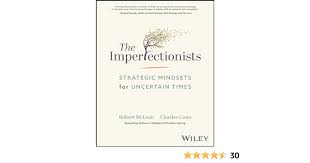
“The Imperfectionists: Strategic Mindsets for Uncertain Times” by Robert McLean and Charles Conn offers insights into navigating uncertainty and complexity in business and life by adopting strategic mindsets that embrace imperfection. Here are the key takeaways from the book:
- Embrace Imperfection: McLean and Conn argue that perfectionism can hinder progress and innovation. Instead, embracing imperfection allows for more adaptive and flexible strategies, which are crucial in uncertain times.
- Strategic Flexibility: The authors emphasize the importance of being strategically flexible. This involves being open to change, adapting plans as new information becomes available, and being willing to pivot when necessary.
- Learning from Failure: Failure is an integral part of the learning process. The book advocates for a mindset that views failures as opportunities for growth and learning rather than setbacks.
- Experimentation and Iteration: McLean and Conn highlight the value of experimentation and iteration. By testing hypotheses, gathering data, and making iterative improvements, organizations and individuals can find better solutions and strategies.
- Decision-Making Under Uncertainty: The authors provide frameworks for making decisions in uncertain environments. This includes considering a range of possible outcomes, assessing risks, and being prepared to adjust decisions as circumstances change.
- Collaboration and Diverse Perspectives: Collaboration and the inclusion of diverse perspectives are essential for effective problem-solving. The book underscores the importance of leveraging the collective intelligence of teams to navigate complex challenges.
- Resilience and Adaptability: Building resilience is key to thriving in uncertain times. McLean and Conn discuss strategies for enhancing personal and organizational resilience, such as fostering a growth mindset and developing adaptive capabilities.
- Focus on Core Values and Purpose: Staying true to core values and a clear sense of purpose can provide stability and direction amid uncertainty. The authors encourage aligning actions and decisions with these foundational elements.
- Continuous Learning: The book promotes a culture of continuous learning and improvement. By staying curious, seeking new knowledge, and being open to feedback, individuals and organizations can better navigate change and uncertainty.
- Balancing Short-Term and Long-Term Goals: Finding the right balance between addressing immediate needs and planning for the future is crucial. The authors discuss strategies for managing this balance to ensure sustainable success.
“The Imperfectionists” provides practical advice for developing strategic mindsets that embrace imperfection, foster adaptability, and enhance resilience. By adopting these approaches, individuals and organizations can better navigate the complexities and uncertainties of today’s world.
“The Imperfectionists: Strategic Mindsets for Uncertain Times” by Robert McLean and Charles Conn is structured around key themes that guide readers in adopting effective strategies and mindsets for dealing with uncertainty. Here’s a brief description of the book’s chapters:
- Introduction: Embracing Imperfection
- The introduction sets the stage for the book by highlighting the necessity of embracing imperfection in a world characterized by uncertainty and complexity. It introduces the idea that traditional approaches often fall short and that new, more adaptive mindsets are required.
- Chapter 1: Curiosity
- This chapter delves into the first mindset, emphasizing the importance of maintaining an insatiable curiosity. It discusses how curiosity drives exploration, learning, and the questioning of assumptions, which are essential for innovation and problem-solving in uncertain times.
- Chapter 2: Dragonfly Eye
- Here, the authors explain the concept of viewing problems through multiple lenses, similar to the multifaceted vision of a dragonfly. This chapter explores how diverse perspectives can lead to a deeper understanding of complex issues and better decision-making.
- Chapter 3: Occurrent Behavior
- The focus of this chapter is on taking action and experimenting rather than waiting for perfect solutions. It highlights the value of learning through doing, iterating based on feedback, and being willing to adapt quickly.
- Chapter 4: Foresight
- Foresight involves anticipating future trends and scenarios. This chapter discusses techniques for long-term thinking and scenario planning, helping readers to prepare for various possible futures and to identify opportunities and risks early.
- Chapter 5: Simplify
- Simplification is key to managing complexity. This chapter explores how to strip away unnecessary elements to focus on what truly matters. It provides strategies for maintaining clarity and reducing cognitive load by simplifying processes, decisions, and communications.
- Chapter 6: Empathy
- Empathy is essential for understanding and addressing the human aspects of any situation. This chapter discusses how to cultivate empathy in interactions and decision-making, fostering better collaboration and communication by considering the needs and perspectives of others.
- Conclusion: Integrating the Mindsets
- The conclusion brings together the six mindsets, emphasizing their interconnectedness and how they reinforce one another. It provides a framework for integrating these mindsets into daily practice to navigate uncertainty effectively and achieve strategic resilience.
Throughout the book, McLean and Conn provide practical examples and actionable insights to help readers apply these mindsets in their personal and professional lives. By adopting these strategies, individuals and organizations can better adapt to and thrive in an unpredictable world.
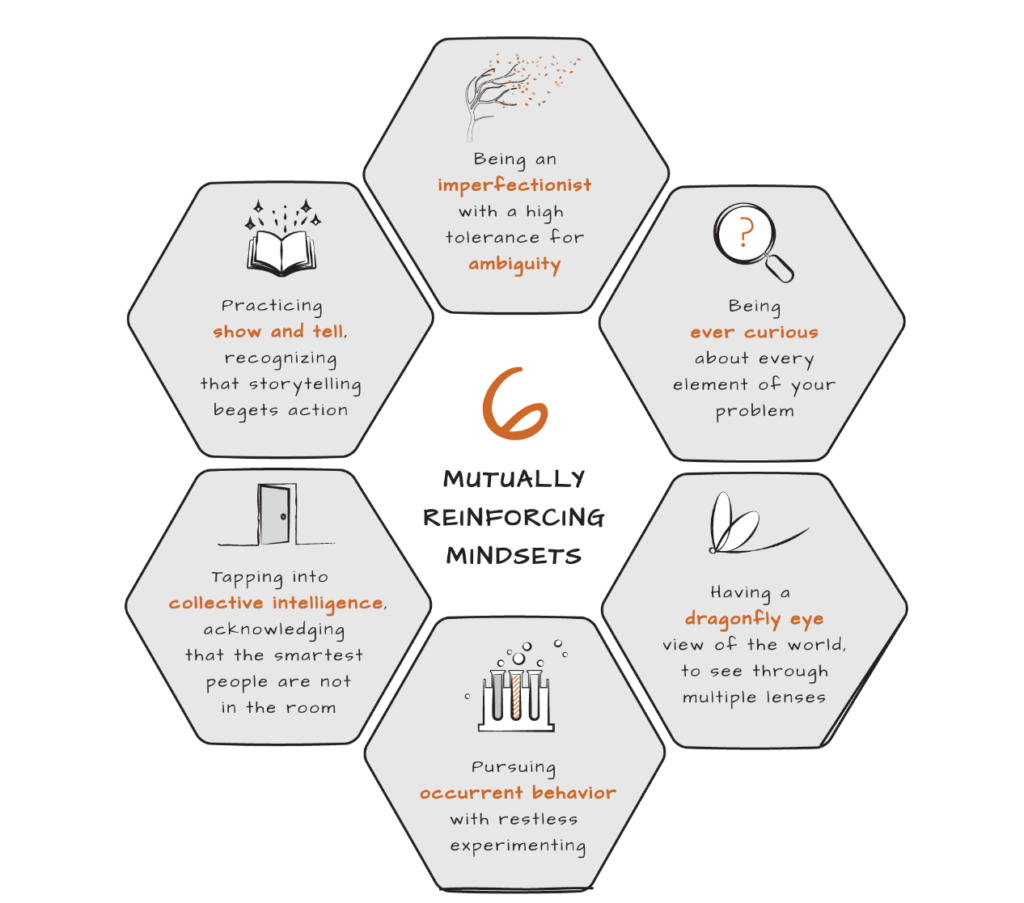
In “The Imperfectionists: Strategic Mindsets for Uncertain Times,” Robert McLean and Charles Conn outline six mutually reinforcing mindsets that help individuals and organizations navigate uncertainty and complexity effectively. Here is a brief description of each mindset:
- Curiosity: This mindset involves maintaining a continuous desire to learn and explore. Being curious means asking questions, seeking out new information, and being open to new ideas and perspectives. It encourages proactive investigation and a willingness to challenge assumptions.
- Dragonfly Eye: Named after the multi-faceted vision of a dragonfly, this mindset emphasizes the importance of looking at problems from multiple perspectives. It encourages considering diverse viewpoints and synthesizing them to gain a more comprehensive understanding of complex issues.
- Occurrent Behavior: This mindset focuses on the importance of action and experimentation. Rather than waiting for perfect solutions, it advocates for trying out different approaches, learning from the outcomes, and iterating based on feedback. It emphasizes doing and learning simultaneously.
- Foresight: This mindset involves thinking ahead and anticipating future possibilities. It encourages long-term thinking and scenario planning to prepare for various potential outcomes. Foresight helps in identifying opportunities and risks that may not be immediately apparent.
- Simplify: In the face of complexity, this mindset stresses the importance of simplifying processes, decisions, and strategies. It advocates for stripping away unnecessary elements and focusing on what truly matters. Simplifying helps in maintaining clarity and reducing the burden of decision-making.
- Empathy: This mindset underscores the importance of understanding and considering the feelings, perspectives, and needs of others. Empathy fosters collaboration and effective communication by ensuring that strategies and solutions are aligned with the human aspects of any situation.
These six mindsets are designed to work together, reinforcing each other to create a comprehensive approach to dealing with uncertainty. By adopting these mindsets, individuals and organizations can become more adaptable, resilient, and effective in navigating complex and changing environments.